
What if a five-star hotel in one destination doesn’t promise the same experience as a five-star stay somewhere else? A 5star label can suggest exceptional comfort and service, but its meaning depends on the rating system behind it.
It’s natural to treat five stars as a guarantee of a particular standard. In practice, classifications vary by country and rating authority, and they don’t always reflect the details that matter most to you. A formal hotel rating is also different from guest reviews, which describe personal experiences rather than classification criteria.
This guide explains what a five-star rating can tell you, why standards differ, and what to compare beyond the star count. Use the practical checks below to weigh service, amenities, location, and your reason for travelling against your own expectations.
Whether you’re considering a city hotel, a Dubai stay, or accommodation elsewhere in the world, understanding the label makes it easier to choose a setting that suits your plans and preferred style of comfort.
Key Takeaways
- Read a 5star classification in the context of the system that awarded it, rather than as a universal checklist.
- Compare guest feedback with property details to understand service style, location, privacy, and room setup.
- Set priorities in order: trip purpose, location, room, services, policies, then rating context.
- Match the accommodation to your plans, whether you’re travelling for business, leisure, family time, or a longer stay.
- Consider how a worldwide hotel stay or Dubai accommodation can complement the experiences on your itinerary.
What Does a 5-Star Hotel Rating Mean for Travellers?
A hotel star rating is a classification assigned under a particular rating system. Five stars can signal a high level of facilities and service within that system, but they don’t represent one globally identical checklist or guarantee that every stay will feel the same. Treat the label as a useful starting point, not a promise of a particular style of luxury.
Several signals shape a hotel’s reputation, and they aren’t interchangeable. A formal classification reflects how a property is assessed against a scheme’s criteria. Guest reviews describe individual experiences, while a hotel brand’s reputation reflects its wider identity. Your own impression depends on what you value, from attentive service to a quiet room or convenient location. The broader overview of Hotel rating systems illustrates how classification approaches differ around the world.
Does five-star mean the same thing in every country?
No single international checklist governs every five-star label. The responsible organization, assessment process, and criteria can vary by destination and scheme. Some systems may consider accommodation, facilities, and services; the exact requirements depend on the classification in use. A 5star hotel in one country may therefore have been assessed differently from one elsewhere.
For a particular destination, identify the rating authority and the scope of its classification before comparing star counts. Country-specific rules can change, so consult the relevant official source for current local criteria.
What can a five-star label tell you at a glance?
It gives an initial indication of a property’s category within its own system. It doesn’t tell you whether a particular room suits your needs, which services are available, or what booking policies apply. Check those details separately, especially if your stay has specific requirements.
For example, a business traveller may value a central location and an efficient setup, while a family may need more space and privacy. Both hotels could hold strong classifications but provide very different kinds of stays.
Keep the signals distinct as you compare options. Guest satisfaction scores and written reviews add perspective, but they’re subjective accounts, not official classifications. Brand reputation can offer another clue, but it doesn’t replace checking the room details, services, and policies for the specific property. Read the 5star label as context, then decide whether the stay itself matches your expectations.
How Hotel Star Ratings Are Assigned Across Different Systems
A hotel’s classification depends on who assesses it and which scheme they use. Some ratings come from destination-specific systems; others come from independent travel organizations. Their names, terminology, geographic scope, and assessment methods differ, so a five-star result in one scheme shouldn’t be treated as directly equivalent to a top rating in another.
A classification scheme evaluates a property against its criteria; a review platform collects guests’ personal opinions. Both can inform a decision, but they answer different questions.
Who decides whether a hotel receives a five-star classification?
Examples of distinct approaches include the Hotelstars Union, which coordinates hotel classification across participating European countries; Forbes Travel Guide, an independent travel rating organization; and the AAA Diamond Program, which assesses hotels in North America and awards Diamonds rather than stars. These schemes have different scopes and shouldn’t be assumed to cover every property or destination.
Assessment methods differ, too. Forbes Travel Guide describes anonymous inspections based on up to 900 criteria, with particular emphasis on service. AAA uses unannounced inspections and its Diamond terminology. For a closer look at its approach, see the Forbes Travel Guide. These examples show why the rating’s source matters as much as its number or symbol.
Which hotel qualities may assessment systems consider?
Depending on the scheme, an assessment may consider the condition and range of facilities, room features, service delivery, and guest-facing operations. The weighting and specific criteria depend on the system. One program may place particular emphasis on service, while another may use its own combination of facilities and operational standards.
Don’t assume a specific amenity, staffing level, or service is required everywhere simply because a property holds five stars. Identify the scheme behind the rating and read its criteria where available. Then check the hotel’s own description for details that shape your stay, such as room configuration, dining options, and included services. A 5star label gives classification context, but it doesn’t replace property-specific information.
For a premium trip, rating literacy is one part of the planning process. You can also explore luxury hotel stays worldwide as you consider which accommodation best complements your destination and itinerary.
Five-Star Classification vs. Luxury Experience: What Should You Compare?
A star category helps explain how a hotel is classified, but it can’t tell you whether the property suits your trip. Weigh the rating alongside guest perspectives and practical details about the room, location, and services. Even the Forbes Travel Guide describes a defined assessment approach, while your sense of comfort remains personal.
| What you’re comparing | What it can tell you | What to look for |
|---|---|---|
| Star classification | The property’s category within a particular rating scheme. | Who issued the rating and what the scheme assesses. |
| Guest reviews | Individual impressions of a stay and its service. | Recurring comments relevant to your priorities, while remembering experiences are subjective. |
| Property information | The specific features and terms of the stay. | Room configuration, location, services, privacy, and booking policies. |
These signals work best together. A traveller on a short business visit may value a convenient location and a quiet place to work, while a family may prioritise a room arrangement that gives everyone enough space. A couple planning a private retreat may care more about atmosphere and seclusion. The right luxury experience is the fit between a property and your priorities, not simply its place in a rating system.
Can a five-star rating guarantee the experience you want?
No. A classification reflects an assessment against a scheme’s criteria; it can’t promise that an individual guest will prefer the atmosphere, service style, or level of privacy. Ratings are still useful for comparing properties. Treat the 5star label as one consideration, then read reviews and examine the specific room and services before deciding.
When assessing a named property, look beyond its category and consider how its location, accommodation, and character align with your plans. The Langham New York hotel case study offers a focused example of evaluating a hotel beyond its label.
When might a private residence suit a traveller better?
A hotel may appeal when you value its style of service and traditional hotel setting. A villa or penthouse may suit you better when your priorities centre on private space or a particular room arrangement. Neither format is universally superior; the choice depends on who’s travelling, the length of the stay, and the pace you want. For another accommodation perspective, explore this Dubai luxury penthouse guide.
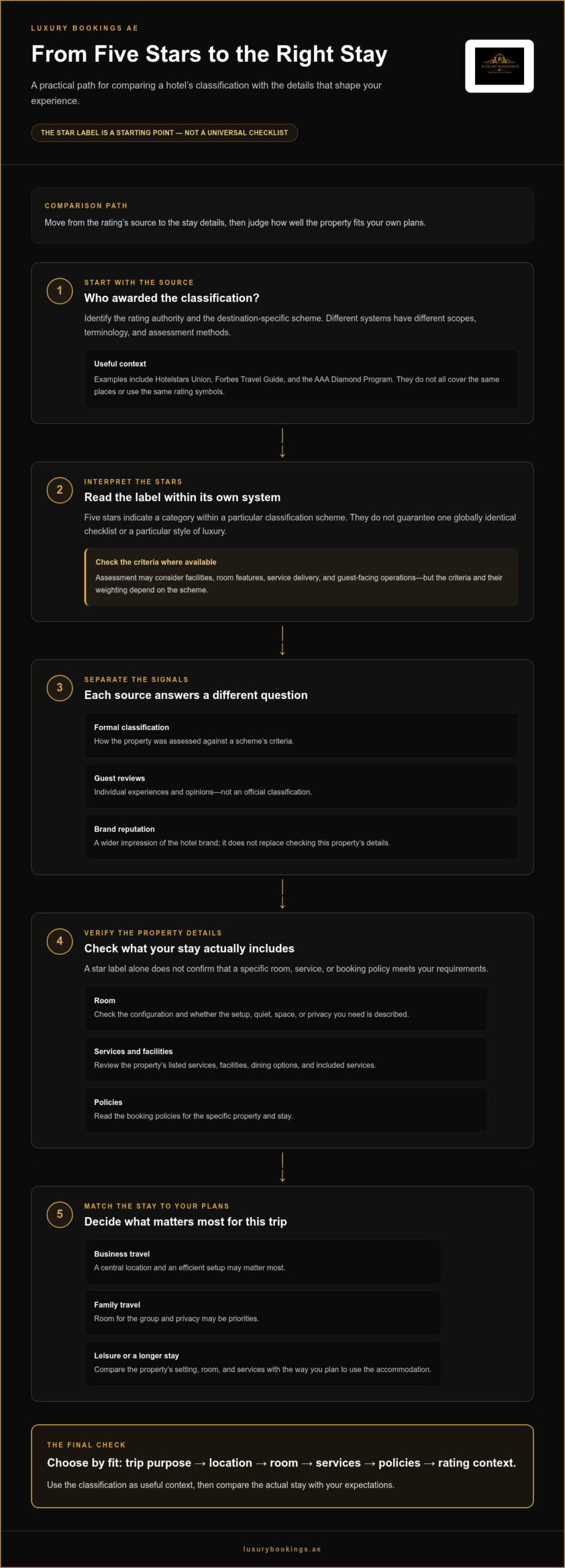
How to Evaluate a Five-Star Hotel Before You Book
Start with your itinerary, not the star count. Use this sequence to compare a five-star property with your trip’s needs, then check the details for the exact room and dates you’re considering.
- 1. Define your trip purpose. Business, leisure, family travel, and a longer stay can call for different room features, services, and surroundings.
- 2. Assess the location. For a short city visit or business itinerary, consider how easily the hotel connects you with planned meetings, sights, and transport.
- 3. Review the room. Check the selected room type, layout, occupancy information, and features. Families may value a suitable arrangement, while longer-stay guests may prioritise space and privacy.
- 4. Compare services and amenities. Check what’s available and included rather than assuming the star category tells the whole story.
- 5. Read the policies. Review current booking conditions and cancellation terms for your chosen room and travel dates.
- 6. Consider the rating context. Identify the classification system behind the stars, then use recent guest feedback as additional perspective, not as an official rating.
Which details should you check beyond the star category?
Focus on the specifics that shape your stay: room type, location, included services, accessibility information, and property policies. Confirm that the descriptions and terms apply to the particular room and dates you’re selecting, since details can differ across options. Recent reviews can offer useful impressions of service or atmosphere, but they reflect individual experiences rather than formal classification.
How should you match a hotel to your trip?
For a brief city visit or business schedule, location and convenience may matter most. For a longer stay, give greater weight to room layout, privacy, and on-property amenities. Families may need a room arrangement that works for everyone. In Dubai, consider how your accommodation fits around planned experiences, such as a desert safari, yacht outing, or Burj Khalifa visit. A well-paced itinerary leaves room to enjoy both the stay and the destination.
Once your priorities are clear, explore luxury stays with Luxury Bookings AE to find accommodation suited to your plans. A 5star classification can frame your search; the room details, policies, and fit with your itinerary help complete it.
Planning a Refined Stay: From Rating Research to the Right Accommodation
A hotel rating is most useful when it helps frame a decision, not make it for you. Once you understand what the classification represents, plan around the complete journey: where you’re going, what you’ll be doing, who’s travelling, and what kind of accommodation will make the stay feel right. A 5star label offers context, while your itinerary and preferences guide the final choice.
How do you build an itinerary around your stay?
Begin with four essentials: destination, dates, purpose, and preferred style of accommodation. A hotel may suit a short visit focused on exploring a city, while a villa, penthouse, or presidential suite may better match a group’s preferences for space, privacy, or a distinctive setting. For a longer stay, consider how the room and property will work with your everyday rhythm, not only your first impression.
In Dubai, accommodation can be one part of a broader plan. You might pair a hotel stay with a desert safari, a yacht experience, or a visit to Burj Khalifa. Consider where each activity fits in your schedule, leaving time to enjoy the property as well as the destination. Luxury Bookings AE provides access to hotel stays worldwide, alongside premium accommodation and experiences in Dubai, so you can consider options across a wider travel plan.
What is the simplest way to use a five-star rating?
Use the rating to understand a property’s classification, then look beyond it before making your choice. This quick review can keep your decision grounded:
- Rating system: Identify the organization or scheme behind the classification.
- Room details: Check the specific room type, layout, and features for your dates.
- Services: Review what the property offers and what is included in the stay.
- Terms: Read the applicable booking and cancellation policies.
- Trip fit: Consider whether the location and accommodation style support your plans.
Choosing thoughtfully doesn’t mean seeking a perfect score. It means selecting a stay that complements the pace and purpose of your trip, whether that’s a hotel elsewhere in the world or a private residence in Dubai. The best accommodation is the one that aligns with your priorities. To explore options for your plans, discover luxury stays and experiences.
Choose a Stay That Fits the Journey
A five-star classification is a useful point of reference, not a universal promise. Rating systems differ, and the experience you value may depend on the property’s location, room, services, and fit with your plans. Treat the 5star label as context, then compare the details that matter to you.
Luxury Bookings AE offers short-term and long-term hotel stays worldwide, alongside villas, penthouses, and presidential suites. For a Dubai itinerary, you can also consider premium experiences such as desert safaris, helicopter tours, yacht charters, and Burj Khalifa visits as part of the wider journey.
Whether you’re planning a city escape, an extended stay, or a carefully curated trip, let your priorities guide your accommodation choice. Discover luxury stays and experiences with Luxury Bookings AE, and begin shaping a stay that feels distinctly yours.
Frequently Asked Questions
What does five-star mean for a hotel?
A five-star label places a hotel in the highest category of a particular rating system. Its meaning depends on the destination and scheme, and it may indicate assessed facilities or services. It isn’t a universal promise of an identical stay. Treat the 5star classification as a starting point, then review the specific room, included services, location, and booking policies before deciding.
Is a five-star hotel rating the same in every country?
No, hotel rating systems and the organizations that administer them can differ across countries and regions. Some destinations use formal classification schemes, while separate travel organizations assess properties within their own scope. Criteria and terminology may not match. To interpret a hotel’s rating, identify the system behind it and consult that organization’s current information rather than assuming the same star count means precisely the same thing everywhere.
What makes a hotel five-star?
The answer depends on the rating system assessing the hotel. A scheme may consider facilities, service, room features, and guest-facing operations, but no single checklist applies universally. Don’t assume a particular amenity or service is included just because a hotel has five stars. For a specific property, read the relevant classification information alongside its current room description and published services to understand what the label means in practice.
Can a five-star hotel guarantee a luxury experience?
No, a five-star classification can indicate a high category within its system, but it can’t guarantee that every guest will enjoy the same experience. Preferences about atmosphere, service style, privacy, and room features are personal. Your trip purpose matters, too: a business traveller and a family may value different things. Use current property details and recent guest feedback as added context, then consider whether the hotel suits your plans.
How are hotels rated from one to five stars?
Hotels are assessed according to the methods of a particular classification or rating organization. The responsible body, eligible properties, assessment process, and criteria can all vary by destination and scheme. Some organizations publish detailed requirements; others use a different approach. To understand a specific rating, find out which system awarded it and consult that organization’s current information instead of assuming there is one global standard for assigning stars.
Are hotel stars the same as guest review scores?
No, a star classification and a guest review score provide different kinds of information. A classification reflects a hotel’s category under a particular rating scheme, while reviews describe individual travellers’ experiences and opinions. Both can help with research, but neither gives a complete picture on its own. Consider the rating alongside current room details, included services, location, booking policies, and feedback that relates to what matters for your stay.
Should I choose a hotel based only on its star rating?
No, use the star rating as an initial reference, then compare the details that will shape your stay. Look at location, room type, included services, accessibility information, and applicable policies. Priorities vary: a short business visit may call for convenience, while a family or long-stay guest may focus on room layout and space. Choose the property whose specific features suit your itinerary, not simply the one with the highest rating.