The most prestigious address isn’t automatically the most private. Choosing secure accommodation for high-profile individuals means looking at how the whole stay fits together, from the property’s layout and access to its location, itinerary and arrival arrangements.
A luxury label doesn’t necessarily signal discretion, and hotels, villas and penthouses each come with different advantages and trade-offs. A hotel may suit a tightly scheduled visit, while a private villa or penthouse may better match a guest’s preference for space and a more contained setting. No accommodation choice alone guarantees personal safety, but thoughtful planning can help align the stay with the guest’s priorities.
This guide offers a practical way to compare those options and assess what a property can and can’t tell you about privacy. You’ll learn how to weigh access, layout and location against the guest’s party and itinerary, and how to handle booking and arrival details with care. Luxury Bookings AE brings together villas, penthouses, presidential suites and hotels for short- or long-term stays, making accommodation one considered part of the travel plan.
Key Takeaways
- Assess privacy as part of the whole stay, while remembering that accommodation alone can’t guarantee personal safety.
- Compare hotels, villas, penthouses and presidential suites using the same criteria, including layout, shared access and service environment.
- Match the property’s location and access context to the guest’s itinerary, party and preferred level of visibility.
- Use a considered booking process: define priorities, compare suitable options and share only the guest and itinerary details needed to arrange the stay.
- Choose secure accommodation for high-profile individuals by weighing practical needs alongside property type and travel plans.
What secure accommodation means for high-profile individuals
For a high-profile guest, accommodation should be chosen according to the needs of the visit. Secure accommodation for high-profile individuals means considering privacy, access arrangements and practical requirements instead of relying on a luxury label. The aim is to find a setting that fits the guest’s profile and plans, with discretion treated as a deliberate part of the booking.
Luxury describes a standard; suitability for a particular stay depends on the guest and the circumstances. A property may offer comfort and an elegant setting, but that alone doesn’t establish how private its operations are or guarantee personal safety. Public visibility, travel plans and the guest’s circumstances all influence which details deserve attention.
Privacy, discretion and personal security are different considerations
A private-feeling room or residence is not the same as professional protection or an emergency response plan. Layout may affect how exposed a guest feels, but privacy also depends on how the stay is handled, including who receives booking and arrival information. No single amenity, property type or “exclusive” label should be treated as proof of security.
For particularly sensitive conversations, specialized facilities are a separate consideration. A Sensitive Compartmented Information Facility (SCIF) illustrates the distinct requirements involved in handling classified information; temporary facilities may be established in hotels. An ordinary guest room should not be assumed to be suitable for such discussions.
Start with the guest’s profile and itinerary
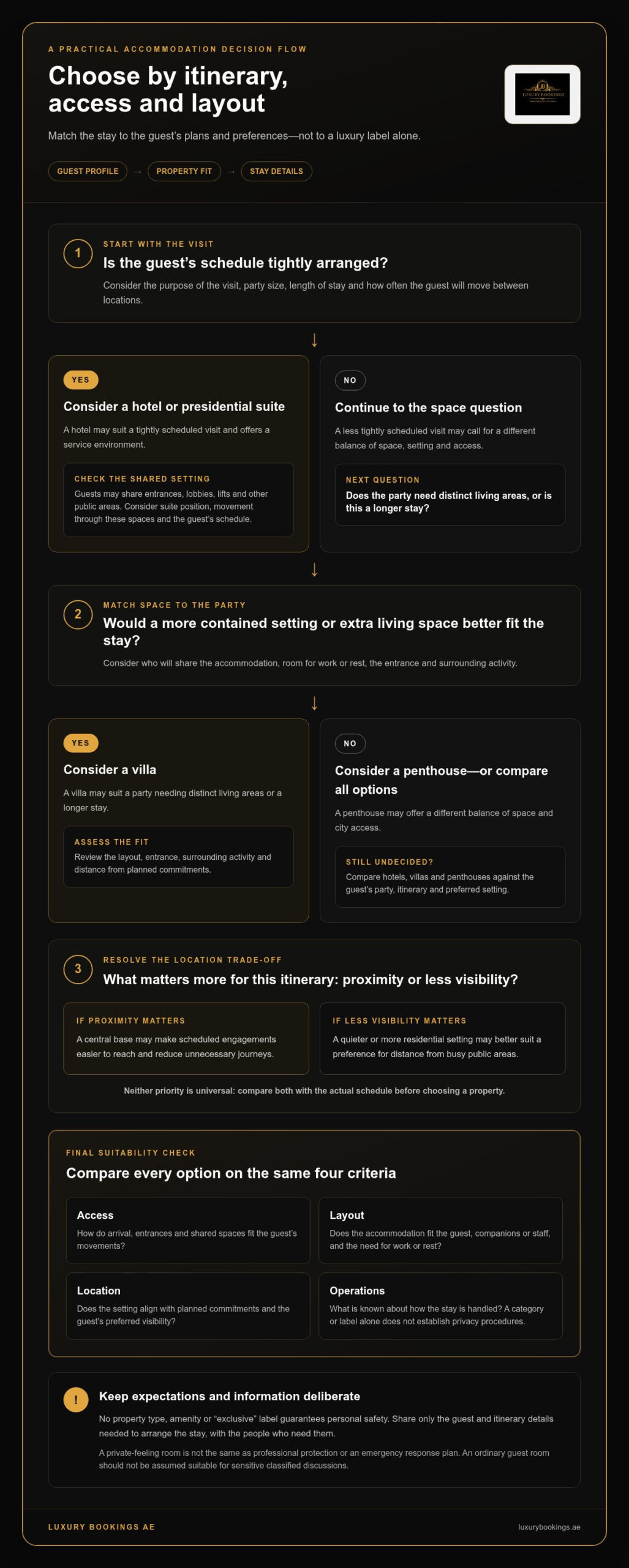
Begin with the practical shape of the visit: party size, purpose, length of stay and how often the guest will be moving between locations. A guest attending several meetings may need a different base from someone travelling with family or planning an extended stay. The right balance depends on the actual schedule, not a generic idea of what a VIP needs.
Consider whether a low-profile arrival or a centrally located base better serves the visit. These priorities can pull in different directions: proximity may simplify movement, while a quieter setting may better suit a preference for less visibility. Compare both against the itinerary before settling on a property type.
Limit personal and itinerary details to the people who need them to arrange the stay. Share essential requirements clearly, without circulating unnecessary information. This helps make the booking more considered while keeping expectations realistic: accommodation can support discretion, but it cannot replace personal security measures.
Which accommodation features support a more discreet stay?
Privacy is shaped by the guest’s movements through a property, not simply the description on a booking page. Consider how arrival works, whether entrances and shared spaces bring guests together, and how the layout accommodates companions or staff. Use these as criteria for comparing options, rather than assuming details from photographs or a property category.
A useful shortlist weighs access, layout, location and operations together. A well-suited location may reduce unnecessary journeys, while a carefully matched layout can give the guest and accompanying party room to move through the stay comfortably. The best balance depends on the itinerary and the level of visibility the guest prefers.
Hotels and presidential suites: service with shared spaces
Hotels offer a service environment, but guests may share entrances, lobbies, lifts and other public areas. Consider how the suite’s position and the guest’s schedule could affect movement through these spaces. A busy arrival or departure time may create a different experience from a quieter schedule. A hotel’s category alone doesn’t establish its privacy procedures, so compare the setting and operations without assuming particular arrangements.
Villas and penthouses: privacy shaped by layout and setting
A villa may suit a party that needs distinct living areas or a longer stay, while a penthouse may offer a different balance of space and city access. Neither property type automatically ensures seclusion. Consider who will share the accommodation, whether there is room for work or rest, the nature of the entrance and surrounding activity, and how far the property is from planned commitments.
For a closer look at Dubai options, explore this Dubai luxury villa rental guide and Dubai luxury penthouse guide. Compare these property types against the guest’s schedule, party size and preferred setting, rather than choosing by label alone.
For secure accommodation for high-profile individuals, assess each option against the same practical criteria. A central base may make scheduled engagements easier to reach, while a more residential setting may better suit a guest seeking distance from busy public areas. The deciding factor is how the property’s access, layout and surroundings align with the actual stay.
Luxury Bookings AE brings together villas, penthouses, presidential suites and hotels for considered stays. Browse luxury accommodation options with the guest’s itinerary and priorities in mind.
How to compare secure accommodation options without relying on labels
Make a meaningful comparison by applying the same criteria to every property, rather than treating “luxury,” “private” or “presidential” as proof of suitability. These labels describe positioning, not how a particular stay will work. Use the table as a starting framework, then assess each property in relation to the guest’s preferences, party and itinerary.
| Property type | Privacy and shared access | Layout and service environment | Itinerary fit |
|---|---|---|---|
| Hotel | Consider shared entrances and public areas as part of the stay. | Review how the room or suite fits the guest’s party and service needs. | May suit a shorter visit with engagements nearby. |
| Presidential suite | Assess access to the suite alongside movement through the wider hotel. | Consider whether the layout works for accompanying guests or work needs. | Compare the hotel setting with the visit’s schedule and preferred level of visibility. |
| Villa | Consider the entrance, surrounding activity and shared areas within the property. | Assess whether the living spaces suit the group and length of stay. | Weigh the setting against the locations the guest needs to reach. |
| Penthouse | Review how the entrance and building’s shared spaces fit the guest’s preferences. | Consider room for companions, staff and private working time. | Compare its setting with the itinerary and desired proximity to planned activities. |
Match the property type to the guest and occasion
A hotel suite may be a natural option for a shorter, service-led visit, particularly when the schedule is built around nearby engagements. A villa or penthouse may be worth considering for a group or longer stay where separate living or working areas matter. These are starting points, not guarantees of discretion. For an example of assessing a hotel stay in context, see the global luxury hotel case study.
Evaluate the whole stay, not only the room
Include arrival and departure, movement through shared areas, and the relationship between the property and the itinerary. A room that appears well suited in isolation may be less practical if it complicates the guest’s daily schedule. Account for family, colleagues or support personnel, too. Their space and routines can shape the right layout as much as the principal guest’s preferences.
Accommodation coordination can bring the property choice into line with stated guest needs and travel plans. It is distinct from specialist security planning, which should be considered separately where required. For secure accommodation for high-profile individuals, the strongest option is the one whose trade-offs best fit this particular stay, not a property type declared universally safest. Explore luxury accommodation options as part of a considered travel plan.
A discreet booking checklist for high-profile accommodation
A composed booking process turns broad preferences into practical decisions without sharing more personal information than necessary. For secure accommodation for high-profile individuals, focus the discussion on the stay: who is travelling, what the property needs to accommodate, where it should be, and how it fits the itinerary. Accommodation planning can support discretion, but it isn’t a substitute for specialist security planning.
Before booking: establish priorities and compare options
Begin with the requirements that will shape the shortlist. Record the guest count, length of stay, preferred location, layout needs and desired service style. Then compare property descriptions against those priorities, rather than letting terms such as “exclusive” or “private” make the decision for you. Note the practical trade-offs so the decision-maker can review the options clearly.
- Define needs. Set priorities for the guest, party and visit, including location, layout and length of stay.
- Shortlist property types. Consider hotels, presidential suites, villas and penthouses in light of the guest’s plans and preferences.
- Compare details. Review the available information consistently, noting relevant access, shared spaces, layout and proximity to planned activities.
- Coordinate the booking. Keep the accommodation discussion concise and share the details needed to arrange the stay.
- Review the plans. Revisit arrival timing and itinerary changes so the arrangements remain aligned with the guest’s schedule.
After selection: organise a composed arrival and stay
Once an option is selected, align the booking details and arrival timing with the relevant travel arrangements. Keep one clear record of confirmed accommodation information and agreed updates, so everyone involved is working from the same plan.
Share only the guest information necessary for the booking with the relevant parties. Treat names, arrival details and itinerary information with care, and use appropriate channels to communicate changes. A concise brief keeps arrangements focused without circulating unnecessary personal details.
This checklist is a planning aid, not a promise of confidentiality or personal safety. Its value is in helping the decision-maker connect the property with the guest’s stated needs, then keep accommodation logistics organised as plans develop. For a considered shortlist of luxury stays, explore luxury accommodation options.
Arrange a considered luxury stay with Luxury Bookings AE
A well-matched stay begins with the guest, not a property label. Location, party size, duration, preferred setting and itinerary all shape whether a villa, penthouse, presidential suite or hotel is the most practical fit. Access context and layout then help refine the choice, while the guest’s priorities keep comfort and discretion in view.
Luxury Bookings AE facilitates luxury accommodation worldwide, including stays in Dubai. Its villas, penthouses, presidential suites and hotels offer distinct settings to consider for short-term or long-term travel. The aim is to bring the accommodation choice into line with the guest’s stated needs and the rhythm of the visit, rather than assume that any property type automatically provides privacy or personal protection.
Bring the guest’s priorities into the accommodation search
Start with a concise brief: where the guest needs to be, who is travelling, how long they’ll stay and what kind of setting they prefer. A compact city itinerary may favour a different base from an extended visit with family or colleagues. These details provide a practical way to focus the search across property types and compare each option against the same requirements.
For secure accommodation for high-profile individuals, the booking decision should account for access context, layout and proximity to planned activities alongside the guest’s comfort preferences. A considered choice supports a more organised stay, but accommodation alone can’t guarantee safety or replace specialist security planning.
Explore luxury stays for your next itinerary
Once the guest’s priorities are clear, accommodation can be considered as one part of the wider travel plan. The selected location and property type should make sense alongside the itinerary and the needs of the party. Keeping those elements connected helps create a thoughtful, composed stay without making unsupported assumptions about a property’s security features.
Discover a luxury stay aligned with the guest’s preferences and travel plans: Explore luxury accommodation with Luxury Bookings AE.
Plan a stay around what matters most
A considered stay begins with the guest’s needs, then brings property type, access context, layout and itinerary into the same decision. Comparing these details is more useful than relying on labels: a hotel, villa, penthouse or presidential suite may suit a particular visit, but no accommodation choice alone guarantees personal safety.
For secure accommodation for high-profile individuals, thoughtful planning also means keeping booking details concise and sharing personal or itinerary information only as needed. These steps can support discretion while helping the guest choose a setting that fits the party, visit and preferred level of visibility.
Luxury Bookings AE offers luxury villas, penthouses and presidential suites, as well as short-term and long-term luxury hotel stays worldwide. Explore options that align with the guest’s preferences and travel plans to take the next step toward a well-considered stay.
Explore luxury accommodation with Luxury Bookings AE. Start with a clear set of priorities to make the search more focused and help shape a memorable journey.
Frequently Asked Questions
What makes accommodation suitable for a high-profile individual?
Suitability depends on the guest’s priorities and the practical context of the stay. For secure accommodation for high-profile individuals, compare location, access, layout, shared spaces, party size and itinerary against specific needs. For example, a guest travelling with colleagues may value a different layout from someone on a short solo visit. A luxury label alone doesn’t establish privacy or security, and accommodation planning is separate from professional personal protection.
Are private villas more secure than luxury hotels?
Neither property type is automatically more secure. A villa may offer a more private setting, while a hotel may have staffed services alongside shared entrances and public areas. The relevant trade-offs depend on the particular property and its operations, as well as the guest’s itinerary and preferred level of visibility. Compare access, layout and location for the specific stay rather than treating a category label as proof of security.
How can a high-profile guest book accommodation discreetly?
Keep the search focused on essential requirements and limit the circulation of personal and itinerary details. Share booking information through appropriate channels with the people who need it to arrange the stay. Compare options against the guest’s privacy preferences and travel plans, then keep changes organised. These steps support a discreet booking process, but they can’t guarantee that information will never be shared or observed.
What should an assistant consider when booking accommodation for an executive?
Begin with the executive’s location needs, schedule, party size, length of stay and preferred accommodation style. Compare each option’s layout, access context and shared spaces against those requirements. For instance, consider whether the stay needs room for accompanying colleagues or a private place to work. Keep sensitive details limited to relevant parties, and coordinate accommodation with the itinerary without treating the booking as specialist security planning.
Can a luxury hotel guarantee privacy for a high-profile guest?
No. A hotel’s luxury status doesn’t, by itself, guarantee privacy. The stay may involve shared entrances, public spaces and operational processes, so assess the particular property in light of the guest’s preferences, schedule and comfort with visibility. Treat marketing language as a description, not a promise of confidentiality or personal security. A careful comparison can help clarify whether the hotel setting suits the guest’s plans.
Is a penthouse or presidential suite better for a high-profile stay?
The better choice depends on the guest and purpose of the visit. A presidential suite may suit a service-led hotel stay, while a penthouse may fit different space or itinerary preferences. Compare layout, location, shared access and the needs of anyone travelling with the guest. Neither option should be assumed to include particular security features, or to provide greater privacy, based on its name alone.
Does secure accommodation replace executive protection?
No. Accommodation selection can support privacy and practical planning, but it isn’t professional personal protection. If a guest has protection requirements, treat those arrangements as a separate consideration. This guide focuses on comparing luxury accommodation and organising a stay around the guest’s stated needs, such as location, layout and itinerary. A well-chosen property may suit those preferences, but it can’t guarantee personal safety.